
.svg)

.jpg)


By Rich Grover, Corporate Finance Partner
The list of buyers most owners carry in their heads no longer matches the market outside. ONS figures published on 1 September 2026 show 162 UK companies acquired by overseas buyers in the second quarter of the year against 130 by domestic ones, down from 241 a year earlier. The field has narrowed everywhere, and it has thinned fastest at home. The starting question is no longer who might want the business. It is who can actually complete.
The mental list is usually three or four names, gathered over a decade of trade shows, industry dinners and the occasional approach that never went anywhere. In the conversations I have with owners across the Midlands, that list is always where the discussion starts, and it carries real value, because it is built on genuine knowledge of who competes and who complements. Its weakness is that it describes the market as it stood when those relationships were formed, and the shape of that market has moved.
Where the domestic buyers went
The quarterly figures are hard to argue with. The ONS counts completed transactions worth £1 million or more where ultimate control of the target changes hands, a fair proxy for the market most privately owned businesses sell into. There were 130 domestic acquisitions in the second quarter of 2026, down from 142 in the first quarter and 241 a year earlier. Overseas acquirers completed 162, also down on the year but far less sharply, which is how they came to be ahead of the domestic figure in both quarters of 2026.
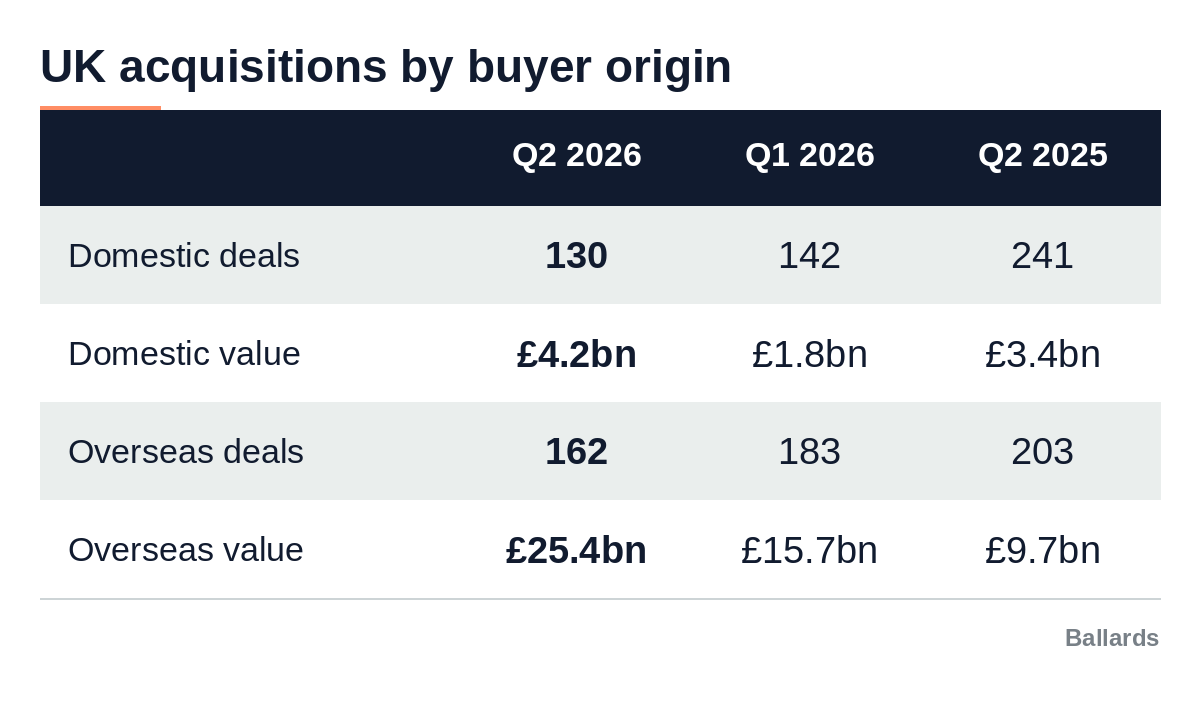
Deal value points the other way, which is where the confusion starts. Both domestic and inward values rose sharply in the second quarter, but a handful of transactions above £1 billion will do that to a quarterly total. Read the headline value and the market looks like it is recovering. Count the transactions and the picture at the lower mid-market end is thinner than it has been in years.
The reasons will be familiar to anyone working in the Midlands M&A market this year. Financing costs have not fallen the way boards assumed they would twelve months ago. Corporate acquirers have spent two years absorbing their own cost increases and have been slow to add integration risk on top. Where trade buyers are active, they are buying to consolidate rather than to diversify, which narrows the field and hardens their view on price. Private equity remains very active in the lower mid-market, but the funds with the least time left on the clock are the ones moving fastest, and they are triaging hard for readiness.
Of course, none of this makes a sale harder in principle. It makes the shortlist less reliable.
What the overseas field actually pays for
Overseas acquirers are rarely paying for the business the owner thinks they are selling. They are paying for a route into a market, a customer base they could not build inside a five year plan, a capability their group does not have, or a platform to bolt further acquisitions onto. That can work in a seller’s favour, because a buyer priced against a five year build cost is not benchmarking against a regional trade competitor. It also changes what has to be true about the business before anyone signs.
3 things come up on every inward process this year and take longer to fix than owners expect:
Reporting has to be capable of consolidation into a group with different accounting conventions, which usually means UK GAAP output presented alongside IFRS-equivalent adjustments.
Customer contracts have to survive a change of control, which means change-of-control clauses read and, where needed, renegotiated before a process starts rather than during one.
Management has to be willing to stay long enough to hand the business over, which usually means a retention structure agreed with the second tier before the founder signals a sale, not after.
There is a timetable consideration as well. The National Security and Investment Act requires mandatory notification for acquisitions in a list of sensitive sectors, and that list is being widened this year to take in water and to separate out semiconductors and critical minerals. The businesses that get caught are rarely the ones that expected to. The filing follows the sector, not the passport of the buyer, and any timetable that stretches is a timetable in which something else can change.
The readiness bar has moved
Buyers used to accept "we will sort that in diligence." In this market, they are increasingly saying "sort it first." Quality of earnings reviews are being commissioned earlier and dug into harder. Working capital positions are being tested in more detail. Questions that used to be closed with a management explanation are now closed with a document.
In my experience, the businesses that invest time getting ready before launching a process are still the ones most likely to achieve the best outcomes. 3 areas are absorbing most of the friction this year:
Working capital. Buyers are pricing normalised requirements more conservatively, and owners who cannot show a clean 12 month picture on request are giving away value that never appears in the headline price.
Customer concentration. The threshold at which concentration becomes a discount has moved down. Contracted revenue behind it helps; a reliance on a small number of customers without it does not.
Systems and data. A business that runs on the founder’s memory and a spreadsheet gets a lower multiple than the same business run on a mid-market ERP with clean master data, and the gap is widening.
Most of this can be fixed with 12 to 18 months of steady work. Very little of it can be fixed in the six weeks between a first meeting and the start of diligence.
What a credible buyer map looks like
For me, a useful buyer map is short and it is written down. For each name there are 3 questions, and the third is the one that usually gets skipped. Why would this buyer want this business rather than any of the others available to them? Where does the money come from? And what does completion actually involve for them, in approvals, timetable and internal politics?
Names that survive all 3 are candidates. Names that survive only the first are aspirations.
The map then tells the seller what to fix. A consolidator will test customer concentration and whether contracts transfer. A financial buyer will test whether the business runs without its founder. An overseas acquirer will test whether reporting can be consolidated and whether the sector triggers a filing. Preparing properly for the 2 or 3 buyers who are genuinely likely is a year of well-directed work with a purpose behind it.
Despite the wider economic challenges, the resilience of the Midlands dealmaking community is one of the things that continues to stand out to me this year, and deal activity remains strong for owners who are ready for it. Preparation is what buys the option to walk away, and the option to walk away is the only real leverage a seller has. Owners who build the buyer map 12 to 24 months out get to choose. Those who wait for the approach to arrive tend to find the choice has already been made for them, by whoever happened to knock.
If you are thinking about exit or succession, or would like to test the buyer list already in your head, please do get in touch with me and the corporate finance team.
This article has been prepared for information purposes only. Formal professional advice is strongly recommended before making decisions on the topics discussed in this release. No responsibility for any loss to any person acting, or not acting, as a result of this release can be accepted by us, or any person affiliated with us.


.svg)
%201.svg)

