
.svg)

.jpg)

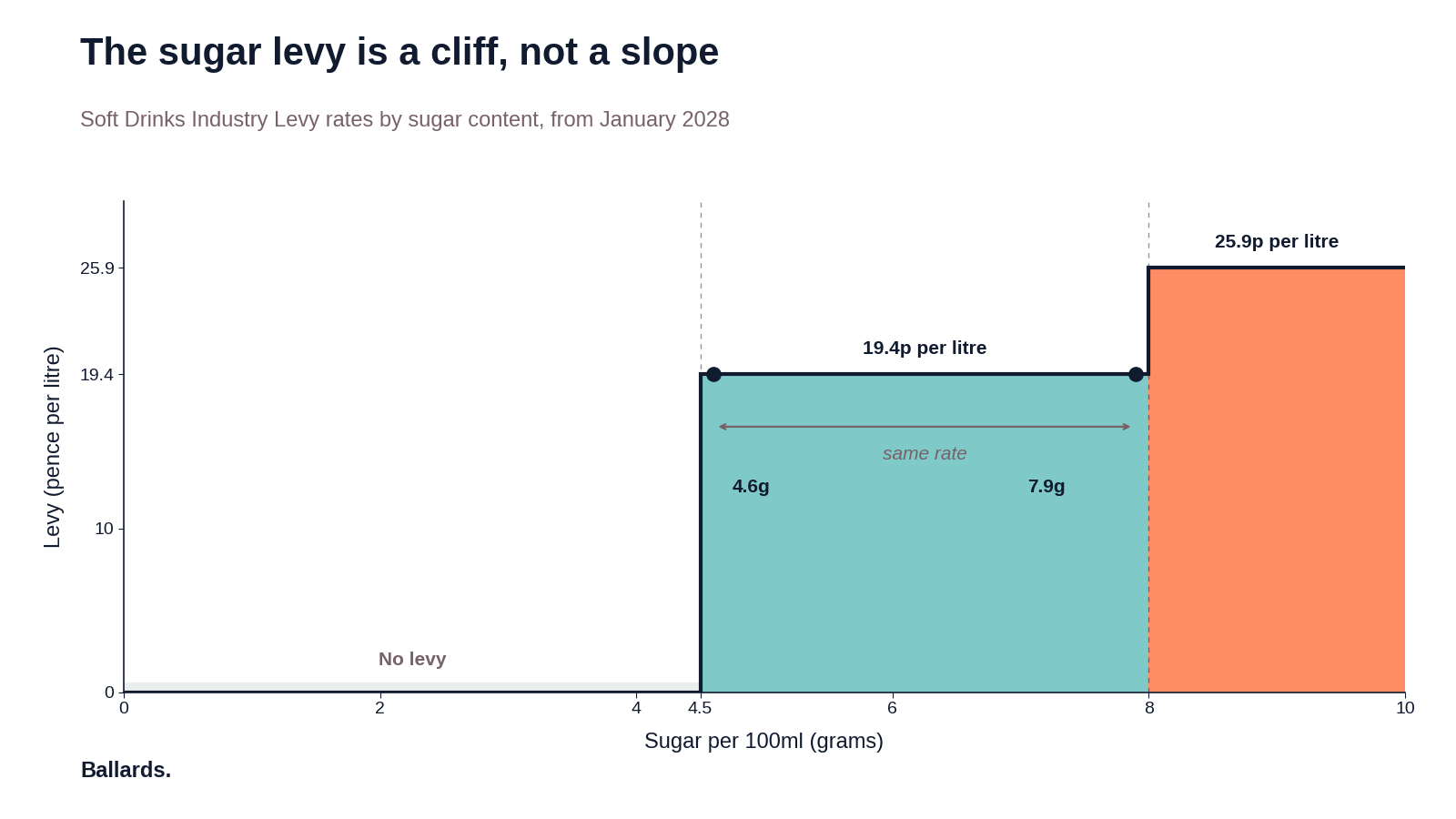
From 1 January 2028, the Soft Drinks Industry Levy applies to pre-packaged milk-based and milk-substitute drinks with added sugar, and the lower threshold falls from 5g to 4.5g of sugar per 100ml. The levy is banded rather than graduated. A flavoured milk that sits at 4.6g once the new lactose allowance is applied pays the same rate per litre as one at 7.9g, which makes 4.5g the only number in the recipe that really matters.
None of that design is new. The banded structure has been in place since the levy took effect in April 2018, and it is the reason so many recipes changed so quickly the first time round. What is new is the range of products the levy now reaches. Bottled milkshakes, sweetened flavoured milks, ready to drink coffees and sweetened plant-based drinks have sat outside it for eight years. From 2028 they are inside it, and a group of businesses that have never operated an indirect tax of this kind become taxpayers.
HMRC published the detail on 13 July 2026, in a policy paper and a technical consultation on the draft legislation. The consultation closes on 6 September 2026, the legislation sits in Finance Bill 2026 and is expected to be enacted in Finance Act 2027, and the changes take effect from 1 January 2028. Most of the coverage since July has asked whether milkshakes will get more expensive. The more useful question for anyone producing them is where the boundaries now fall and which products are standing on the wrong side of them.
What does the lactose allowance actually change?
The government has accepted that naturally occurring lactose should not be taxed. When working out whether a milk-based drink meets the threshold, producers disregard lactose that occurs naturally in milk and in milk products such as milk powder. The exceptions are lactose or galactose added as a separate ingredient, hydrolysed lactose, and lactose present in whey powder, all of which count towards the total. In practice the calculation becomes a question of added sugars rather than total sugars, which is a better outcome than much of the sector expected when the review was announced.
The catch is in the evidence. HMRC has said it does not intend to be prescriptive in legislation about the form the records take, but it has set out what it may ask for: a recipe sheet showing quantities in grams per 100ml, supplier specifications confirming the typical lactose content of milk-based ingredients, a description of the manufacturing process demonstrating that lactose is not introduced separately, and laboratory analysis where it exists. Where the evidence is thin or absent, HMRC can determine the position itself using established composition data. A producer whose formulation is genuinely better than the published averages will not get the benefit of it unless the paperwork carries the claim.
That matters more here than it would under a graduated tax, because of how the bands work. Between 4.5g and 7.9g per 100ml the levy is a flat 19.4p per litre, and at 8g and above it is 25.9p, with rates set at each Budget and taking effect the following April. There is no reward for being nearly compliant. The levy either applies to a product in full or it does not apply at all. A producer who takes a drink from 7g down to 5g has spent money on reformulation and saved nothing, while one who moves the same drink from 4.7g to 4.4g has removed the charge altogether.
Where do the other boundaries sit?
Two further thresholds deserve more attention than they have had. The first is drinking yoghurt, which stays outside the levy only where the product is at least 90% fermented milk before other ingredients are added, and where no other liquid has been added to make it more drinkable. A product at 89% is in scope. Thinning a yoghurt drink with milk or juice to improve how it pours is now a tax decision as well as a texture one.
The second sits in the plant-based range. A milk substitute whose sugars come only from its single core ingredient, such as oats or soya, remains out of scope. Where the drink contains sugars from two or more plant-based ingredients, liability is determined by reference to the drink's total sugar content, and an additional sugar-contributing ingredient derived from the same plant, rice syrup added to rice milk being the example HMRC gives, is treated as added sugar. The consequence is easy to miss. The second ingredient does not simply add its own sugar to the calculation. It moves the whole product onto a total sugars basis, which for an oat or rice drink can be a very different number. This is the kind of detail that gets overlooked when a technical consultation lands in the middle of July, and it is worth reading before 6 September rather than after.
Who actually pays the levy on an own-label milkshake?
The levy is charged on the packager and the importer, not the brand owner. Under Part 2 of the Finance Act 2017 a business that packages liable drinks for someone else has to register regardless of its own brand volume, and the small producer exemption, which applies below one million litres in a rolling twelve months, is available to businesses packaging their own drinks. Quarterly returns require litres packaged for yourself and litres packaged for others to be reported separately.
For a regional dairy filling own-label flavoured milk for a retailer, that means the levy lands on volume it does not own, does not brand and does not price. Whether it can be recovered depends entirely on the supply agreement. Contracts negotiated while milk-based drinks were exempt are unlikely to contain a clause that anticipates this, and in the audit work I do across food and drink, tax change provisions in own-label supply agreements are either absent or drafted narrowly enough to cover VAT and nothing else. That is a commercial conversation worth starting in 2026, not a fortnight before the first return falls due.
"There is no reward for being nearly compliant. The levy either applies to a product in full or it does not apply at all."
Is this really a 2028 problem?
There is a reasonable argument that it is not urgent. HMRC's own impact assessment describes the administrative impact on business as negligible, identifies around 100 UK producers and importers not already registered for the levy, and puts the exchequer yield at £40m a year from 2028 to 2029. Around 11% of soft drinks sales fall within the changes, and the government expects only an additional 4% of sales to actually pay the levy once reformulation has taken place. On those figures this is a modest tax touching a small number of registrations, with sixteen months to prepare.
I would read the same figures the other way round. A measure that brings 11% of the market into scope and expects to collect from 4% is not primarily a revenue measure. It is a reformulation programme, and the gap between those two numbers is the volume of product the government is assuming will have its recipe changed. Every one of those changes has to pass through sensory work, stability and shelf-life trials, a retailer range review and a print run. Sixteen months buys one annual range review cycle, not three. The businesses that reformulated successfully in 2018 did so because they started early, and the ones that paid the levy for years afterwards were mostly the ones that waited to see whether the policy would stick.
The work worth doing before the end of this year is not complicated. Take every drink in the range and calculate where it sits against 4.5g with the lactose allowance applied, using the evidence HMRC has said it will look for rather than the front-of-pack nutrition panel. Identify the products sitting between 4.5g and 8g, because those are the lines where a small formulation change carries a disproportionate return and where doing nothing is the most expensive option. Confirm which legal entity is the packager for each product. Then read the own-label contracts. Anything that comes out of that exercise and needs the draft legislation to change is worth putting into the consultation while it is still open.
The levy has always rewarded precision over effort. From 2028 it rewards it across a much wider shelf.
If you would like to test where your range sits against the new thresholds, our food and beverage team is always happy to talk it through.
This article has been prepared for information purposes only. Formal professional advice is strongly recommended before making decisions on the topics discussed in this release. No responsibility for any loss to any person acting, or not acting, as a result of this release can be accepted by us, or any person affiliated with us.


.jpg)
.jpg)

.jpg)
.svg)
%201.svg)

