
.svg)

.jpg)


By Nita Kotecha, Senior Manager, Healthcare
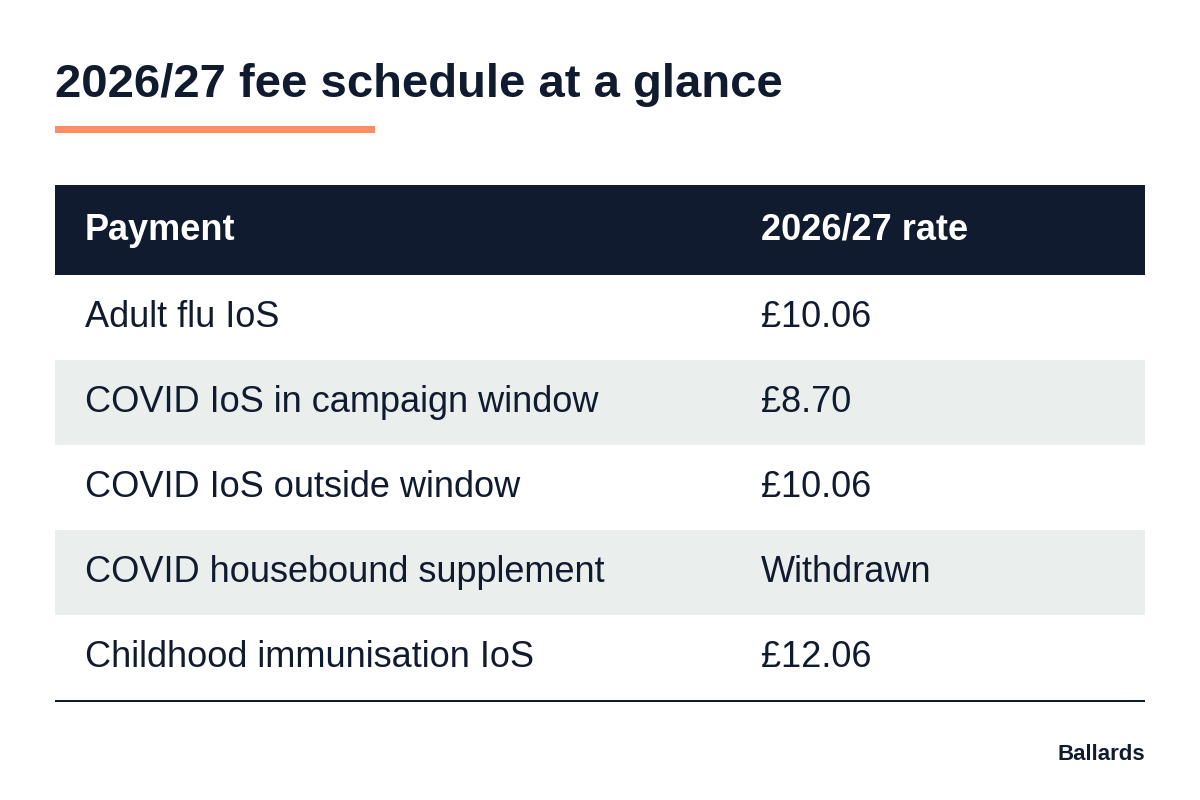
The 2026/27 combined flu and COVID vaccination service pays £10.06 per adult flu dose, £8.70 per COVID dose during the campaign window from 1 September 2026 to 31 January 2027, and £10.06 per COVID dose outside it. The £10 housebound supplement has gone. The adult flu item of service fee has now been frozen at £10.06 for the fourth consecutive season, while the employer's cost base has moved considerably in the opposite direction, and every practice signing up should model the true unit cost of delivery before finalising the autumn plan.
What has actually changed in the 2026/27 vaccination service?
The most significant structural change is that adult flu and COVID have been brought under a single combined service specification for general practice. Practices sign up at practice level rather than through their PCN, and can choose to deliver both programmes or opt into flu only. The commissioned cohort is patients aged 18 and over; flu vaccinations for two- and three-year-olds and for children in clinical risk groups are commissioned through a separate enhanced service.
Recording moves onto GPIT clinical systems for both flu and COVID, retiring the point-of-care system and the Manage Your Service platform used in previous seasons. Requirements around surge, service pausing and site designation have been aligned across the two programmes. For care home residents and housebound patients, the offer remains mandatory, and PCN member practices are still required to collaborate on the care home cohort.
The 2026/27 fee schedule at a glance:
Do the item of service fees still cover the true cost?
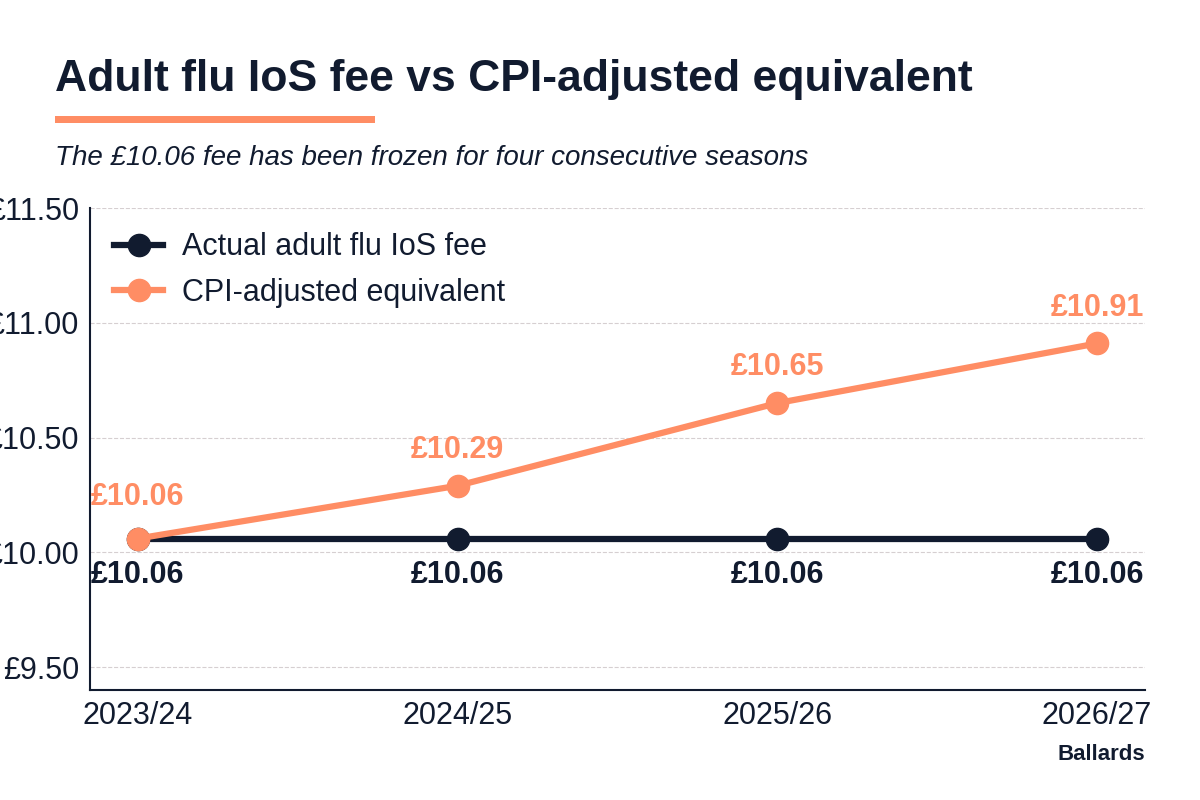
This is where the arithmetic becomes uncomfortable. The adult flu IoS fee has held at £10.06 through 2023/24, 2024/25, 2025/26 and now 2026/27. Over the same period the employer's National Insurance rate rose from 13.8% to 15%, the secondary threshold at which employer NI starts fell from £9,100 to £5,000, and the National Living Wage rose to £12.71 an hour from April 2026, up 4.1% on the year before. None of that has been reflected in the fee.
The COVID fee has moved, but modestly and only by giving something up. The £10 supplement previously paid for administering COVID to housebound patients has been removed, and the underlying IoS fee has been raised to £8.70 in the campaign window and £10.06 outside it. NHS England's own letter to practices is candid that the fee uplift is partly funded by the removal of the housebound supplement. Whether the swap makes a practice better off or worse off depends almost entirely on the ratio of housebound to clinic-based patients on its list.
"The adult flu fee has held at £10.06 for four seasons running. Employer national insurance, staff wages and the housebound supplement have all moved against it."
Where does the housebound supplement withdrawal hurt most?
Home visits are the single most expensive delivery model in the vaccination programme, and the £10 supplement existed for good reason. They take a clinician out of the practice, involve travel, cannot be batched in the way a clinic can, and the yield per hour is measurably lower than an in-house cohort. Removing the supplement makes the marginal economics of housebound vaccination worse for every practice, and more sharply so for those with a high proportion of frail elderly or dependent patients, or for practices covering rural geography.
The requirement to offer vaccination to housebound patients has not changed. That offer remains contractual. What has changed is the funding model that used to acknowledge its higher cost. In practical terms, practices need to decide whether the housebound cohort is delivered by their own team, through a PCN collaborative arrangement, or by a specifically resourced community team where one exists. The choice has cash-flow consequences either way.
Which delivery model is most likely to be viable?
The 2026/27 specification permits vaccinations on practice premises, in patients' homes and in care homes. Any other location requires the commissioner's approval. Within that framework, the operating margin varies dramatically by delivery model. A batched clinic, with a nurse or vaccinator running structured slots, gives the highest throughput per pound of paid time. A drop-in model running alongside routine appointments is more accessible but produces variable throughput and much higher time-per-vaccination. Housebound and care home visits are the lowest yield per hour and now attract no additional payment.
PCN collaboration is worth revisiting for the care home cohort in particular. The underlying specification now formally requires PCN member practices to collaborate on care home residents. In conversations with practice managers over the last few weeks, the recurring point is that PCN-level care home clinics consistently beat single-practice delivery on cost per dose, but only where the network has done the practical work of route planning, consent management and vaccine allocation in advance of the campaign starting.
What should every practice model before finalising the autumn plan?
Four numbers matter. First, the projected uptake in each eligible cohort. NHS data for the 2024/25 season showed 74.9% coverage for over-65s, 40% for at-risk under-65s and 35% for pregnant women, and any practice-level plan should start from its own equivalent baseline rather than a national average. Second, the true blended cost per vaccination, taking in vaccinator time, room time, admin overhead, cold chain and wastage, and the employer NI on all of it. Third, the reimbursement cash-flow profile, since IoS fees are claimed monthly through FP34 and reimbursement for the vaccine itself sits with NHSBSA. Fourth, the size of the housebound cohort and where responsibility for it sits.
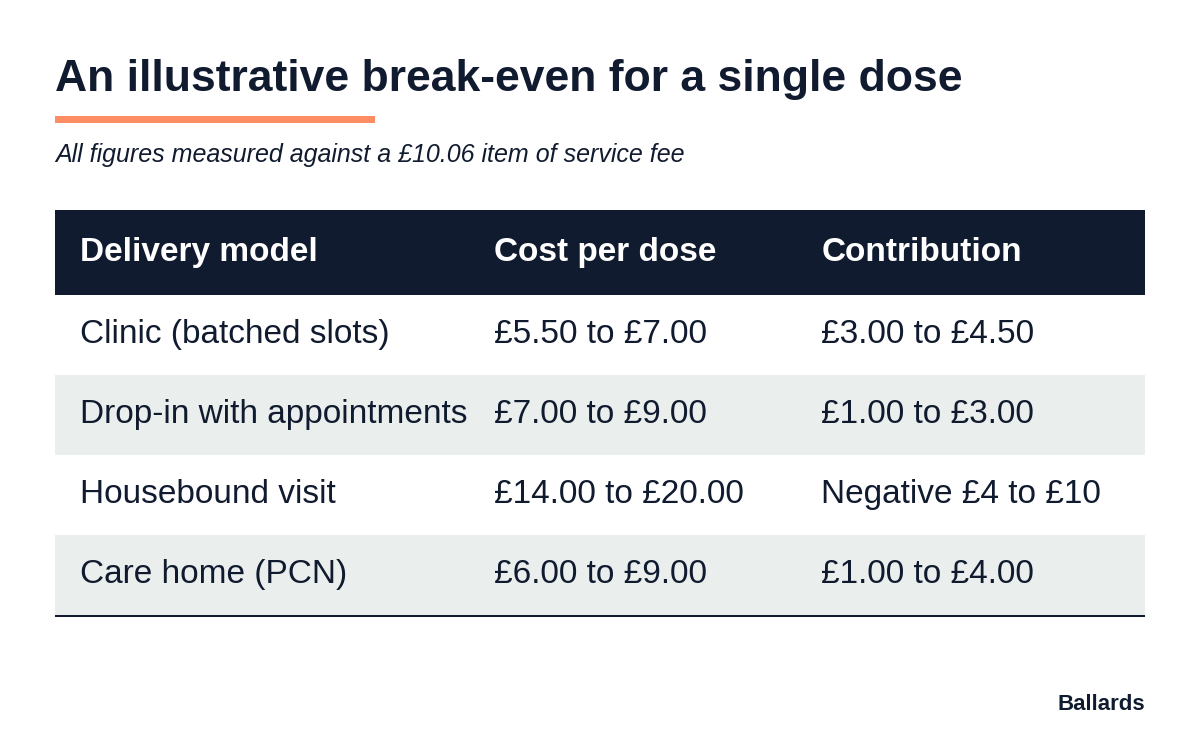
Ranges will vary by staff mix, geography and list demographics. The housebound figure is a shortfall because a home visit costs the practice more per dose than the £10.06 fee returns, once travel, clinician time and consumables are counted. The PCN care home model is normally the more efficient route for the housebound and care home cohort.
Getting this right takes an hour of proper modelling rather than a review of last year's spreadsheet, and it is worth doing before the first week of October when the campaign hits volume. If a fresh look at your practice's vaccination economics would be useful, our healthcare team is glad to run the numbers alongside you.
This article has been prepared for information purposes only. Formal professional advice is strongly recommended before making decisions on the topics discussed in this release. No responsibility for any loss to any person acting, or not acting, as a result of this release can be accepted by us, or any person affiliated with us.
Sources: NHS England, 2026/27 COVID-19 and adult influenza vaccination service specification for general practice (December 2025); NHS England, General practice enhanced service specification – COVID-19 and adult influenza vaccination programmes, 1 April 2026 to 31 March 2027; NHS England, Flu Vaccination Programme 2026/27; NHS England, Changes to the GP Contract in 2026/27 (24 February 2026); HMRC, employer National Insurance rates 2025/26 and 2026/27; Department for Business and Trade, National Living Wage rates from April 2026; Office for National Statistics, CPI 12-month rates April 2023 to April 2026.


.jpg)
%20(1)%20(1).jpg)
.jpg)
.jpg)
.jpg)
.svg)
%201.svg)

