


By Emma Clewes, Corporate Tax Director
For accounting periods beginning on or after 1 January 2027, many UK businesses with cross-border related-party transactions will need to file an International Controlled Transactions Schedule (ICTS) alongside their corporation tax return. With a reporting threshold as low as £100,000 per transaction category for groups outside Country-by-Country Reporting, far more mid-market and owner-managed international groups will be caught than by traditional transfer pricing rules. Here is what is changing, who is in scope and what to do now.
Executive Summary
The UK government's new International Controlled Transactions Schedule (ICTS) represents the most significant change to UK transfer pricing compliance in many years.
From accounting periods beginning on or after 1 January 2027, many businesses with cross-border related-party transactions will be required to file a detailed ICTS alongside their corporation tax return. The first filings are expected from 2028 onwards. HMRC intends to use the information to undertake automated, data-led transfer pricing and permanent establishment (PE) risk assessments.
Unlike traditional transfer pricing documentation, the ICTS requires structured transaction-level data rather than narrative explanations. HMRC will be able to compare taxpayers across industries, jurisdictions and transaction types, making it easier to identify businesses whose pricing arrangements differ from HMRC's expectations.
For many mid-market groups, the ICTS will be the first time detailed transfer pricing information must be disclosed in a standardised format directly with the tax return.
What is the ICTS?
The ICTS is a new annual reporting schedule that accompanies the corporation tax return and requires entities within scope to report information about:
- Cross-border related-party transactions.
- Overseas permanent establishment dealings.
- Transfer pricing methodologies.
- Counterparty jurisdictions.
- Transfer pricing adjustments.
- Profitability and financial outcomes.
The regime was introduced under powers contained within Finance Act 2026 and follows a multi-year HMRC programme aimed at increasing transfer pricing transparency and improving risk assessment capabilities
Who is potentially within scope?
The ICTS may apply to:
UK resident companies
UK companies within the scope of the UK's transfer pricing legislation.
UK companies with overseas permanent establishments
Including foreign branch operations.
Overseas companies with UK permanent establishments
Including foreign groups carrying on business through a UK PE.
Certain partnerships
Partnerships with corporate members where UK transfer pricing rules apply.
Who is likely to be outside scope?
Generally:
- UK-only groups with no cross-border related-party transactions.
- Many businesses benefiting from the SME transfer pricing exemption.
- Certain transactions covered by an effective Advance Pricing Agreement (APA).
However, businesses should be careful not to assume that being relatively small automatically excludes them from ICTS reporting requirements.
Understanding the Reporting Thresholds
One area causing confusion is that the ICTS effectively has two materiality thresholds.
- Groups within Country-by-Country Reporting (CbCR)
Where the multinational group is required to submit a Country-by-Country Report, the reporting threshold is generally:
£1 million per transaction category
This will normally apply to very large multinational groups with consolidated annual revenues exceeding the OECD CbCR threshold.
Example:
Result:
- Management services not reportable.
- Royalties reportable.
- Loan interest reportable.
- Non-CbCR Groups
Groups which are not within Country-by-Country Reporting generally apply a lower threshold of:
£100,000 per transaction category
This is particularly relevant for many owner-managed and mid-market international groups.
Example:
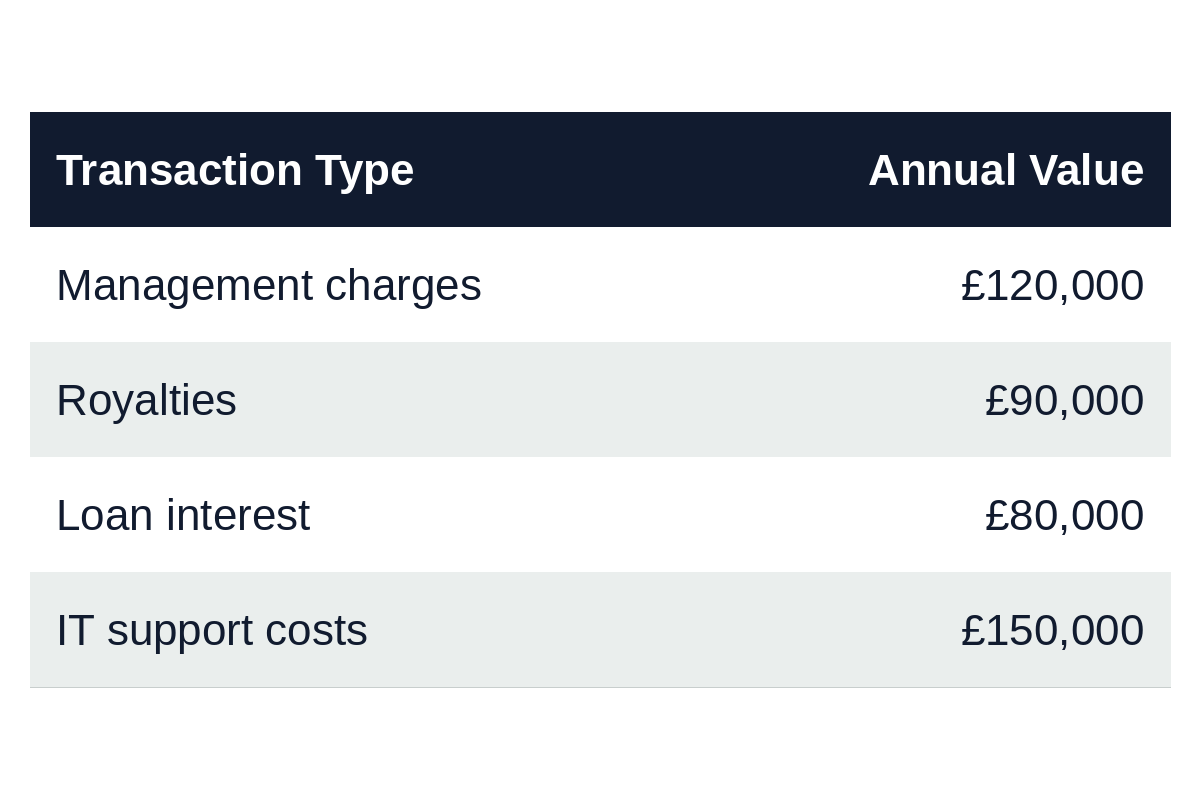
Result:
- Management charges reportable.
- IT support reportable.
- Royalties not reportable.
- Loan interest not reportable.
What transactions are caught?
The scope is deliberately wide.
Services
Examples include:
- Management charges.
- Finance and accounting support.
- HR services.
- IT support.
- Shared service centre costs.
- Procurement support.
Financing Transactions
Examples include:
- Intragroup loans.
- Cash pooling arrangements.
- Treasury functions.
- Financial guarantees.
- Intercompany interest.
Intellectual Property
Examples include:
- Royalties.
- Trademark licences.
- Technology licences.
- Know-how payments.
- Brand charges.
Goods Transactions
Examples include:
- Inventory purchases.
- Manufacturing arrangements.
- Distribution activities.
- Contract manufacturing structures.
Business Restructuring Transactions
Examples include:
- Transfer of functions.
- Transfer of risks.
- Transfer of intellectual property.
- Supply chain reorganisations.
Permanent Establishment Dealings
A significant feature of the ICTS is that it extends beyond legal transactions and captures notional dealings for PE attribution purposes.
Examples include:
- Head office recharges.
- Branch support functions.
- Internal financing arrangements.
- PE profit attribution calculations.
What information must be reported?
The draft ICTS template published by HMRC indicates that reporting will include both quantitative and qualitative information.
Typical fields include:
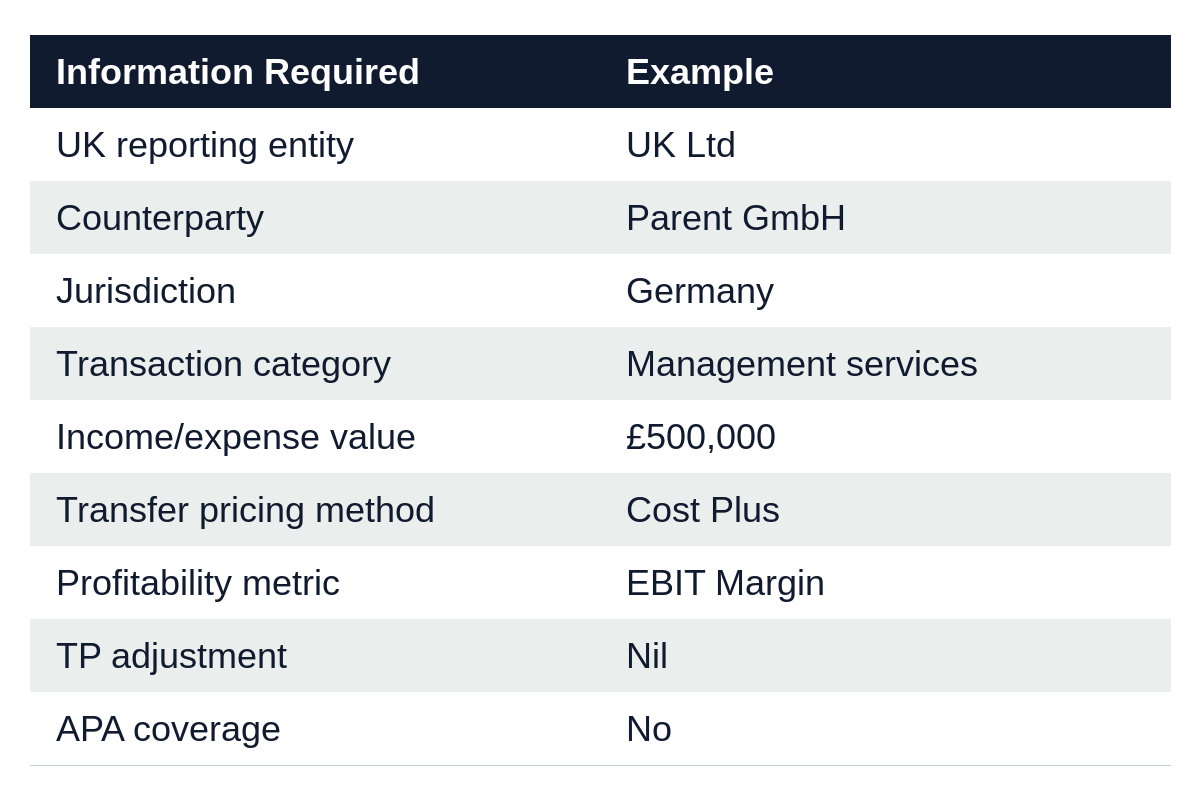
The final filing will be digital and considerably more detailed than information typically found within statutory accounts or tax computations.
Example of ICTS Reporting
A simplified illustration is shown below.
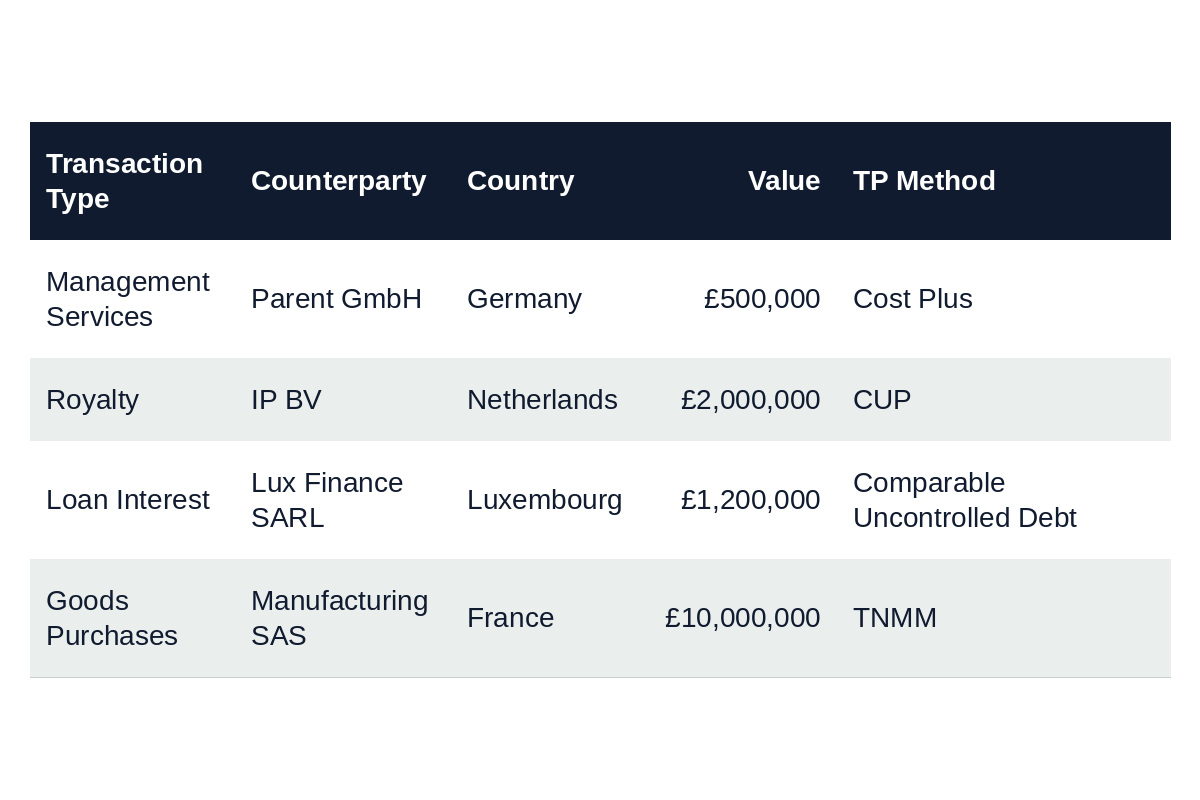
The actual ICTS submission will require additional supporting information regarding profitability, transfer pricing adjustments and other risk indicators.
Practical Implications for Businesses
Businesses should not assume they can compile ICTS disclosures from:
- Statutory accounts.
- Corporation tax computations.
- Existing transfer pricing reports.
Many businesses will need to identify:
- Individual transaction streams.
- Relevant counterparty jurisdictions.
- Supporting transfer pricing methodologies.
- Source accounting data.
- Profitability metrics by transaction category.
What Should Businesses Be Doing Now?
We recommend that internationally active businesses undertake an ICTS readiness review during 2026 and early 2027.
Key areas include:
- Transaction Mapping
Identify all cross-border related-party transactions.
- Threshold Assessment
Determine whether reportable transaction categories exceed applicable thresholds.
- Transfer Pricing Review
Confirm that transfer pricing policies remain supportable and commercially appropriate.
- Data Readiness
Assess whether accounting and ERP systems can provide the information required by the ICTS.
- Documentation Review
Identify gaps in transfer pricing documentation before the first filing period.
- Permanent Establishment Review
Revisit existing PE analyses and profit attribution methodologies.
Our View
For many mid-market groups, the £100,000 threshold means the ICTS will affect a far wider population than traditional transfer pricing compliance obligations.
Particular attention should be given to businesses with:
- Overseas parent companies.
- Intragroup financing.
- Shared service arrangements.
- Cross-border management charges.
- Intellectual property arrangements.
- Overseas branches or permanent establishments.
The ICTS represents HMRC's move towards data-driven transfer pricing compliance. Businesses that prepare early are likely to be better placed to manage risk, reduce enquiry exposure and minimise future compliance costs.
If you are unsure whether your group's intragroup arrangements will be caught, or whether your systems can produce the data the ICTS will ask for, now is a sensible time to find out. I am always happy to talk through what a readiness review might look like for your business, and you can read more about how we support internationally active groups on our Corporate Tax page
This article has been prepared for information purposes only. Formal professional advice is strongly recommended before making decisions on the topics discussed in this release. No responsibility for any loss to any person acting, or not acting, as a result of this release can be accepted by us, or any person affiliated with us.